
- Travel Navigator
- Current Tours
- Women's Tours
- Exotic Travel
- Special Group Tours
- Image Gallery
- Cape Town Flora
- Savuti Camp, Botswana
- Tubu Tree Camp, Botswana
- Chitabe Lediba, Botswana
- Jack's Camp, Botswana
- Ruckomechi, Zimbabwe
- 2015 Ecuador-Napo Jungle
- 2014 Mandrare, Madagascar
- 2014 Manafiafy, Madagascar
- 2014 Andisibe, Madagascar
- 2014 Masaola, Madagascar
- 2013 Galapagos Tour
- 2012 Primates Primer, Uganda
- 2010 Women's Walking Tour, Kenya
- 2009 Amazon Botanical Tour
- 2009 SE Asia Tour
- 2009 Buenos Aires Art Tour
- 2008 South Africa & Madagascar
- Macchu Picchu, Peru
- Past Trip Archive
- 2014 Textiles Tour of Burma
- 2013 Karisia, Kenya Women’s Walking Safari
- 2013 Textiles Tour of Burma
- 2013 NTBG - Southern India
- Northern India Textiles Tour 2011
- Visual Arts Tour of Buenos Aires 2009
- NTBG Amazon 2009
- Womens Tour of South East Asia 2009
- NTBG Madagascar & South Africa 2008
- Women's Baja Adventure 2007
- Cultures and Arts of South India 2007
- NTBG Myanmar & Thailand Tour 2004
- Women's Tibet Trek 2004
- NTBG Bhutan Tour 2002
- Cantores France Tour 2002
- Women's Tibet & Nepal Adventure 2000
- About Us
- Contact
Terra Nova Travel
Professional trip designing for the inquisitive, independent and intrepid
Women's Tibet & Nepal Adventure 2000
Musings on a Nepal & Tibet Adventure
 In preparation for
this trip, I became fascinated with Tibetan Buddhism numerology.
Numerology of the West was already a part of my psyche, especially
in relationship to the numerology of the Catholic Church-multiples
of the Trinity. In my Footprint Tibet Handbook by the Tibetan
author, Gyurme Dorje, I stumbled upon the Glossary. The etymology
of words and numerology reveal the soul of a culture. Buddhism
has no less than three synonyms for temple-stupa, chorten and
chaitya. The number eight figures prominently in the Buddhist
consciousness:
In preparation for
this trip, I became fascinated with Tibetan Buddhism numerology.
Numerology of the West was already a part of my psyche, especially
in relationship to the numerology of the Catholic Church-multiples
of the Trinity. In my Footprint Tibet Handbook by the Tibetan
author, Gyurme Dorje, I stumbled upon the Glossary. The etymology
of words and numerology reveal the soul of a culture. Buddhism
has no less than three synonyms for temple-stupa, chorten and
chaitya. The number eight figures prominently in the Buddhist
consciousness:
- 8 Attributes of Pure Water (coolness, sweetness, lightness, softness, clearness, soothing quality, pleasantness and wholesomeness)
- 8 Auspicious Symbols Tashi Tagye (umbrella, fish, conch, eternal knot, vase, wheel, flower and victory banner)
- 8 Chorten (Stupas or Chaitya) symbolizing the Major Events of Buddha’s Life (birth, subjugation of Mara, enlightenment, teaching, descent from Tusita - after teaching his late mother, victory, revelation of miracles and decease.
- 8 Taras who Protect From Fear A group of female divinities, who offer protection from 8 specific types of fear.
EIGHT (GYE)
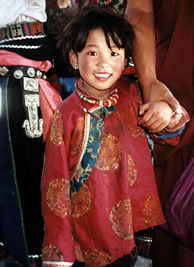 At Tashilhunpo Monastery, ShigatseCoincidently on Christina
Wilson’s most recent trip seven women accompanied her to Nepal
and Tibet, two of the great Himalayan countries. Christina, who
I dubbed “the rainmaker”, had assembled a diverse group of seven
women, a sculptress, a homemaker, a once upon a time theatre
directress, a computer saleswoman, a pastry baker, a para-legal
and a jewelry maker. Although some members knew each other, their
only one common connection was Christina. Two women marked the
passage of their half century on the trip.
At Tashilhunpo Monastery, ShigatseCoincidently on Christina
Wilson’s most recent trip seven women accompanied her to Nepal
and Tibet, two of the great Himalayan countries. Christina, who
I dubbed “the rainmaker”, had assembled a diverse group of seven
women, a sculptress, a homemaker, a once upon a time theatre
directress, a computer saleswoman, a pastry baker, a para-legal
and a jewelry maker. Although some members knew each other, their
only one common connection was Christina. Two women marked the
passage of their half century on the trip.
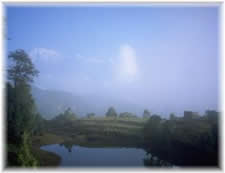
Having trekked a half dozen times in Nepal, Christina selected a less frequented area in the foothills near Pokara, Panchasi Lekh. The five day trek followed a ridge above Phewa Tal (a large lake) with a sweeping view of the Annapurna range (snowy peaks at elevations of 22-25,000). While without the complications of high altitude hiking, the trek did present its own challenges-muddy trails, leeches and some steep descents. On the final night the intrepid trekkers’ reward was their home stay in the Gorkha village of Sirubari during the height of the Hindu festival, Dasain.
 NINE
(GU)
NINE
(GU)
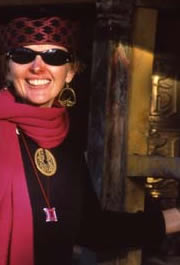
Converging in Kathmandu the eight (Gye) and I, the travel agent, and the ninth member (Gu), all continued on together to Tibet. In Tibet we encountered not only the physical demands of a high altitude environment, but also those of a completely foreign culture and people. Barred to individuals without special connections, travel into Tibet requires that visitors travel with a group. The current minimum requirement is five tour members. It is possible to organize one's own group or join one with a "set departure" which should be prearranged prior to travel.
In Lhasa, we discovered the “formal” Tibet at the Potala Palace, the official home of the Dalai Lama, but Tibet’s heart is the famous square, the Barkhor, and its soul is the Jokhang Temple. We obtained unique glimpses of daily life at a Buddhist nunnery and a local carpet factory owned by our tour escort’s family. For the next three days we made our pilgrimage from Lhasa, on a bumpy, dusty road trip visiting the monasteries of Drepung on the outskirts of Lhasa, Tashilhunpo, home of the Panchen Lama in Shigatse and the fortress style Phalkor in Gyantse with the Nepalese style Kumbum Chorten. We literally dropped down into Lhasa over the Karola pass (about 17,000 ft), wending our way on serpentine roads. At the Karola pass, as a thanksgiving offering to the supreme beings we proudly hoisted our prayer flags a la Tibetan style.
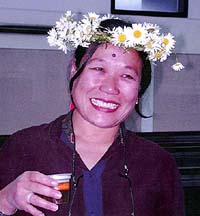 But then there were ten… our guide, Doma. As a Tibetan, she
and most of her family now reside in Nepal and the USA. Doma
is about 5’1” in height with long black hair, a “moon” face with
a mole, centered on her forehead that resembles a permanent tika.
Like her famous countryman, the Dalai Lama, Doma, appears to
be forever smiling. Although she is not dancer thin, she has
a dancer’s sense of her body. Her movements are graceful and
flowing. In Tibetan, her name, Doma, signifies Tara, the Goddess
of Compassion. Doma immediately became one of us. She lead us
through fields of leeches, bouts of altitude sickness, but most
of all she gave us a better understanding of the “ INSCRUTIBLE
EAST” through her ability to help our Western eyes “see” her
rich cultural and spiritual heritage.
But then there were ten… our guide, Doma. As a Tibetan, she
and most of her family now reside in Nepal and the USA. Doma
is about 5’1” in height with long black hair, a “moon” face with
a mole, centered on her forehead that resembles a permanent tika.
Like her famous countryman, the Dalai Lama, Doma, appears to
be forever smiling. Although she is not dancer thin, she has
a dancer’s sense of her body. Her movements are graceful and
flowing. In Tibetan, her name, Doma, signifies Tara, the Goddess
of Compassion. Doma immediately became one of us. She lead us
through fields of leeches, bouts of altitude sickness, but most
of all she gave us a better understanding of the “ INSCRUTIBLE
EAST” through her ability to help our Western eyes “see” her
rich cultural and spiritual heritage.
No adventure is complete without one that challenges the palate.
Here are two of the delectable dishes Doma made for the 50th
birthday party for one of our little band she hosted at her Kathmandu
home.
 Badam Santeko - Peanut relish
- 2 cups of raw shelled peanuts -roast in pan, let cool and remove pink skin.
- 4 cloves of garlic cut in slithers.
- 1 thumb-size piece of fresh ginger, remove skin and cut in small strips.
- 2 - 4 fresh hot red and green chillies cut in diagonal thin strips.
- 1 - 2 stalks of scallions cut diagonal thin strips.
- juice of a half lemon or lime.
- salt to taste.
- 1 tbl of mustard oil or olive oil.
- Optional - chopped coriander leaves (cilantro.)
Place prepared peanuts, garlic, ginger, chillis, scallions in a mixing bowl. Add the juice of lemon or lime, oil and salt to taste and voila! you have Badam Santeko. Serve with cocktails.
 Apple Momos
Combine the following for the filling:
- 2 apples cleaned and grated.
- 1 tbl of honey or sugar.
- 1 tbl (or less) of butter.
- a slight sprinkle of cinnamon and clove powder.
Dough:
2 cups of flour kneaded with just water and let sit for a while.
Roll out small flattened round disks (Try for thinner edges and thicker centers). Place some filling in the center of the dough and close the edges by pressing with your thumb. When the wrapping of the momos is completed, place in steamer and steam for 20 minutes. Serve hot.
All photos courtesy of Christina Wilson and Nancy Pole-Wilhite
except Nancy at the prayer wheel by photo by Rosalie Brandon.
The stamp illustrations are by Reed Wilson.